Shortcuts

Venturer in the underworld
Published in
The hidden realm of caves has opened up a new world to scientists and explorers thanks to speleologists such as Francesco Sauro whose many expeditions have provided an archive of time for future generations.
The world’s deepest, darkest and most mysterious places exert an irresistible fascination over Francesco Sauro, a Rolex Awards for Enterprise Laureate who ventures into caverns beneath the Amazonian forest, the mountains of Europe and distant isles of the Atlantic Ocean.
All videos
2021
Venturer in the underworld
2014
Inside the labyrinth


Sauro is a speleologist – a caver – and scientist, bent on a lifelong mission of discovery in the underworld, uncovering million-year-old mysteries of the life that dwells within the deep Earth.
As a child, his fears of the dark were transformed by caving expeditions with his father into northern Italy’s Lessini Mountains. “The curiosity overcame the fear and then I realized there was an entire world down there,” he recalls.
He learned about the Rolex Awards at age 12. Inspired by 1993 Laureate and fellow countryman Antonio De Vivo – who had explored caves in Mexico – Sauro joined the La Venta Association of Speleologists and began participating in expeditions to remote regions. Among these were the tepuis, isolated table-top mountains that soar above the jungles of Colombia, Venezuela and Brazil.

The tepuis held a powerful allure for the young explorer, “not just because they are beautiful, which of course they are, but because, inside, they’re actually a kind of lost world,” he says. Erupting out of the dense rainforest that blankets south-eastern Venezuela and northern Brazil, the chain of rugged quartzite plateaux forms dramatic landscapes. Hollowed deep within these rocky turrets are extensive, winding caverns and watercourses harbouring a unique geology and life forms that have evolved over tens or hundreds of millions of years, isolated from the surrounding world – a time capsule dating back to the dinosaurs.

Since 2009, Sauro has led 12 expeditions into this region, scaling the vertical walls of the tepuis, or rappelling from a helicopter to explore an underworld never seen before. His venture in 2014 resulted in a Rolex Award to advance these scientific expeditions – and through this he met another Laureate, young Saudi microbiologist Hosam Zowawi, who was eager to discover new life forms for his battle to save human lives from antibiotic resistance. In 2016, the pair joined forces in an expedition to the tepuis that harvested unusual microbial species thriving in the darkness of these caves through unknown metabolic mechanisms.
With every step, you are looking at something which is new to humanity.
Sauro’s scientific work is gradually revealing the strange processes whereby life, water and geochemistry combine to shape these unique environments, forming a hidden record of climate change.
His most recent expedition to a speck of an island, part of the Selvagens archipelago in the north-east Atlantic, has revealed caves in volcanic rock that are millions of years old. It is a tiny world unto itself where “with every step, you are looking at something which is new to humanity”.

Despite their remoteness, the Selvagens Islands in the past were in danger of being ruined by human misuse but fortunately are now protected within a natural reserve managed by the Portuguese government. Their volcanic innards are filled with unknown ancient microbial life and their crags are honeycombed with hollows where seabirds have bred for millions of years. In this expedition, funded by the Portuguese Foundation for Science and Technology (FST), Sauro and microbiologist Ana Zelia Miller, from the University of Evora, have been leading a multidisciplinary team of scientists to shed light on the scientific treasures hidden within the interior of these islands.
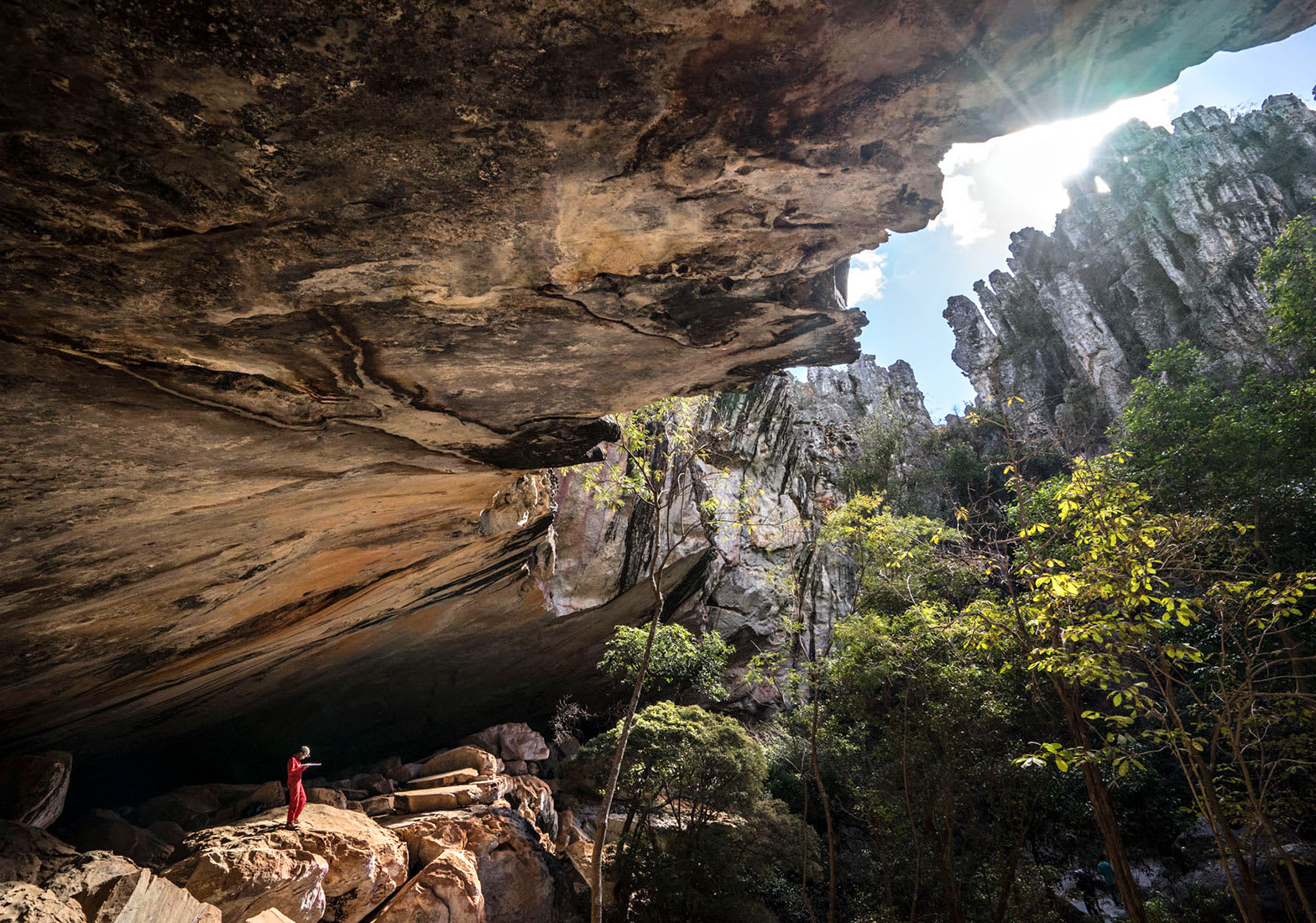
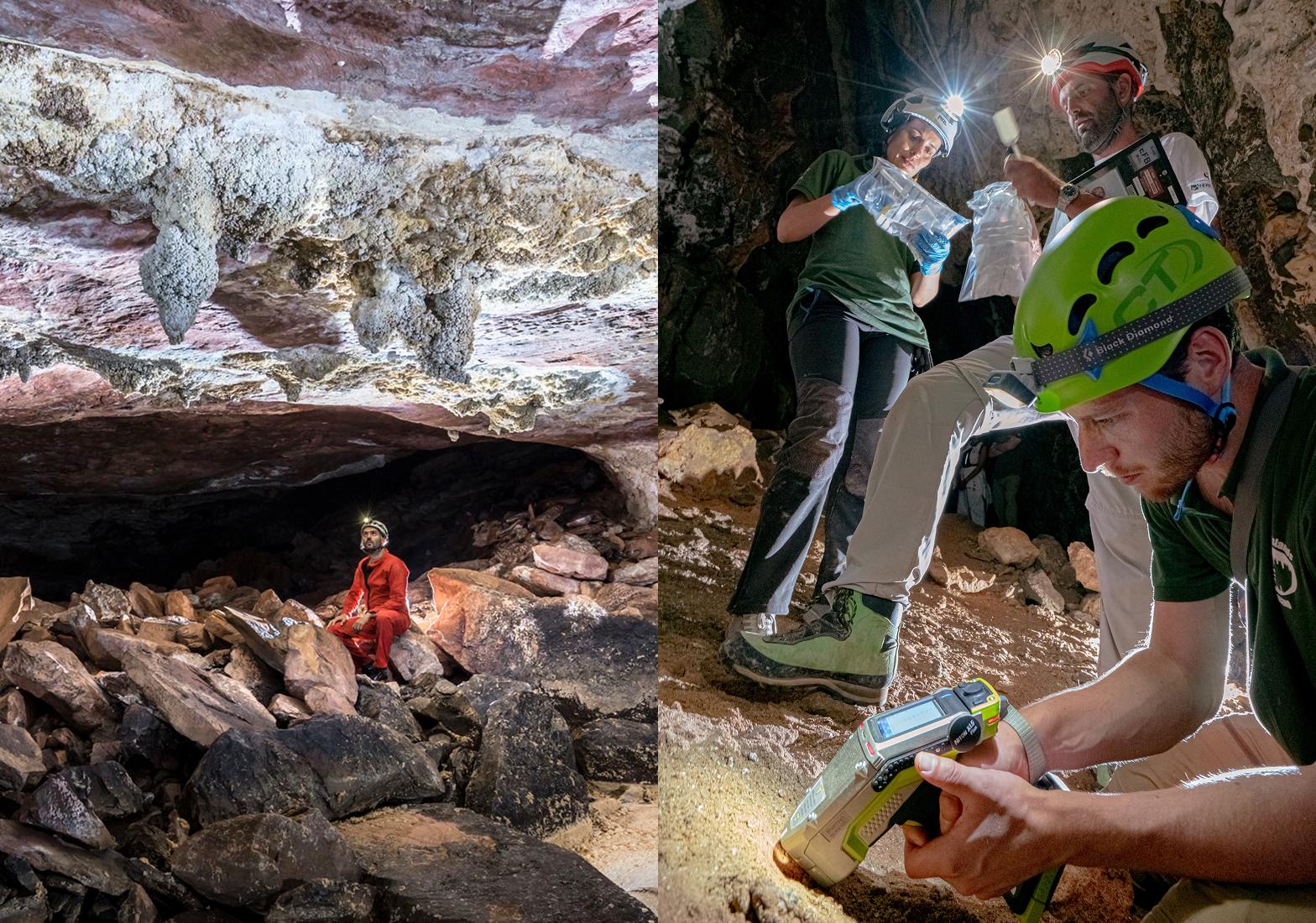
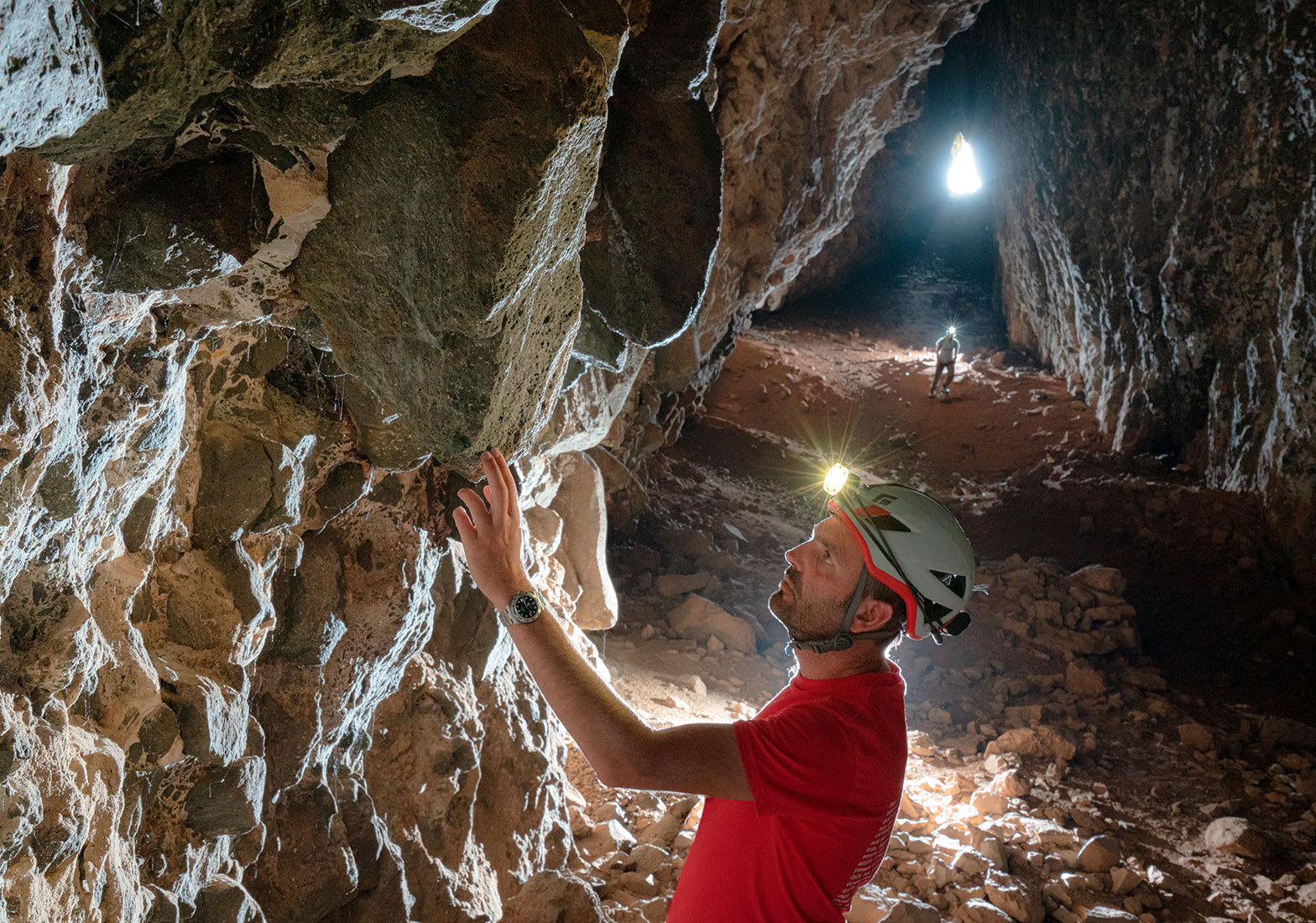
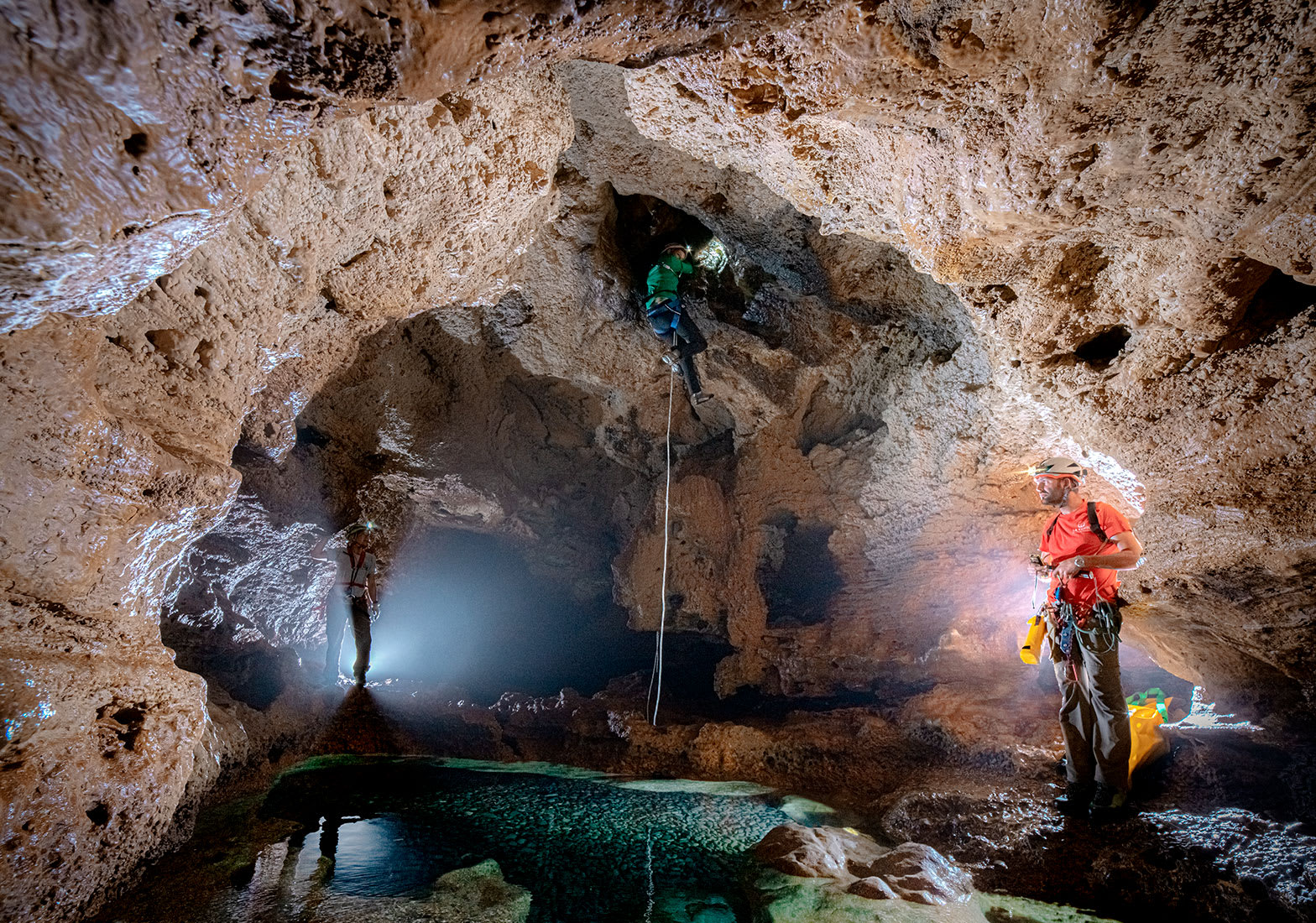
Volcanic caves such as those in the Selvagens offer a tantalizing glimpse of the future. In collaboration with the European Space Agency, Sauro employs their unfamiliar terrain to train the next generation of astronauts for what it may be like to live and work in other-worldly environments – such as the Moon or Mars – where humans must be shielded from cosmic radiation. “The caves are like a small planet,” he explains. They also offer a living laboratory to which he brings the latest scientific field equipment to analyse both the rocks and the life in their hidden places. “When you go in a cave, you are entering a kind of archive of time, so everything is preserved and you can dig into the past to see how life evolved, how minerals formed, how the climate has changed,” Sauro reflects.
A cave is a kind of archive of time: everything is preserved and you can dig into the past to see how life evolved, how minerals formed, how the climate has changed.
His latest ventures include using drones to obtain 3D maps of the dangerous melting heart of glaciers, where humans dare not venture, in places such as Greenland – with fellow Rolex Awards Laureate Joseph Cook – and Switzerland. He is also planning a new expedition to the tepuis of Chiribiquete in Colombia’s Amazonian jungle, together with the local indigenous populations, to enable them to explore of these pristine regions of our planet.

“Less than 10 per cent of the world’s caves have ever actually been explored,” Sauro points out. “Of these only around 100 have been investigated using modern molecular biology methods. This means the life of the deep subsurface of our planet is largely unknown and may harbour many unique forms that humans have never before encountered.” He also collaborates with Rolex Awards Laureate and acoustics expert Michel André on the significance of sound in caves where outside sounds never penetrate. Together they are developing a new science, speleo-acoustics.

For Sauro, there are complex motivations to exploring caves. In his eyes, the caverns form a benchmark for life on Earth that has never known the intervention of humans – as well as a haven for new species to be conserved. For the local people of the Amazon jungles, the clouded tepuis are the homes of the gods, a cultural and religious icon in their community – and he intends to safeguard this heritage.
Through Sauro’s work, the concept of Rolex’s Perpetual Planet initiative is being fulfilled in a harmonious weaving of intrepid discovery, insight and understanding. Within our old familiar world, a new one is being revealed, full of wonder.